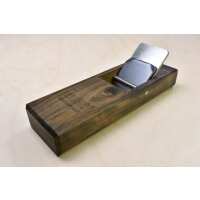
Every Mujingfang plane is crafted by hand from a single piece of carefully selected air dried timber, shaped and finished with scrapers to expose the natural sheen of the wood. This 180mm flat profile plane is built with a body of African Jackalberry (Diospyros mespiliformis), a beautifully figured species of ebony.
Taiwanese style planes have a simple iron secured with a metal wedge, similar to a Japanese chipbreaker. The difference is that on a Japanese plane the iron is held independently and the chipbreaker can be removed or added at will, whereas on a Taiwanese plane the wedge is simply there to hold the iron in place.
The HSS iron is hardened to RC63-64, well within the RC70 the steel is potentially capable of, but still harder than most tool steels. With this heat treatment the HSS is easy to sharpen and delivers a very pleasant balance of edge retention and toughness.
If you're just getting started with oriental planes, this flat profile is a great place to begin, giving a straightforward, dependable plane for flattening and smoothing flat work before moving on to the curved profile sizes.
Mujingfang Flat Profile Ebony Plane 180mm
African Jackalberry (diospyros mespiliformis) ebony body
180mm overall length, flat profile
58mm sole width
45mm Tungsten Molybdenum HSS blade, cryogenically hardened to RC64
Bedding Angle 42.5°
Sprung cap iron, usable on push or pull stroke
Length/Profile
Blade
Best suited to
180mm curved
41mm HSS, RC64
Fine shaping of curved and coved surfaces, chair seats and shallow hollows
220mm curved
40mm HSS, RC64
General curved-surface smoothing and larger coves
245mm curved
48mm HSS, RC64
Longer, flowing curves that benefit from a longer sole to true them evenly
180mm flat
45mm HSS, RC64
Flattening and smoothing straight, flat work; a good introduction to Oriental planes