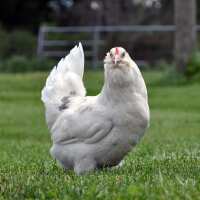
“The baby chicks are ADORABLE!! My chicks arrived bright and alert! It’s only been a day and already I can see a bit of personality forming! I’m sooo excited for this new journey!”
“Yang (paired with Yin, a Black Copper Maran) has a sweet personality and is very friendly. She is the only one in our 4-chicken flock who is nice to the Silked Easter Egger and protects her when the other girls try to chase her off. Yang is very inquisitive and if I am pulling weeds while the girls are out, she will gently nibble on me to see if I am edible. The moment she hears us open the door she runs full bore toward us. A chicken in full run is ... hilarious. As advertised, she has a walnut comb and was a copious layer of large, blue eggs for a month and a half.... until she went broody on the first day the temps went up to 80. I don't like to separate them, so I have been removing her from the nest (and she is very sweet about that too) but she is quite persistent in her broodiness. I would just let her brood, but she won't let the other girls in the nest box with her -- I have to manage their laying and it's a pain.”
“We bought some of these hens three years ago when they were first called super blues. Everyone one of them have laid like champions, pouring out these beautiful blue eggs. Each stunning hens. I came back last year and ordered six more. All six of the new girls are now also cranking out eggs like crazy. As you pointed out could be the case, two of these hens are not white with black flecks. They are white with what looks to be lavender flecks, small single combs. And they both lay a large cream colored egg. I’m not disappointed at all, I think they are beautiful and unique! And the few cream colored eggs are really attractive mixed with the abundant aqua blue. Thank you so much for offering this cross! They really rock!”
What a fantastic update! It’s wonderful to hear that your Super Blues (Bountiful Blues now :-) have been such amazing layers and that you’ve had such a great experience with them. The unique variations in color make your flock even more special, and the mix of aqua blue and cream eggs must be absolutely beautiful! Thank you for sharing your experience—we love hearing how much you’re enjoying your girls!
“We love our little Tina! Her blue eggs are so pretty. She’s the tiniest chicken of our flock but started laying the first at 21 weeks old. She is sweet, curious, and spunky and doesn’t seem to mind the cold.”
Thank you for sharing about Tina! She may be the tiniest in your flock, but it sounds like she has a big personality! Her early laying, sweet nature, and cold-hardiness make her such a wonderful addition. Enjoy those beautiful blue eggs!
“Supa Star is the sweetest little hen ever! She started laying the most beautiful pale aqua eggs at 24 weeks in the dead of winter. As a chick she was a little shy, but as she grew she got so friendly and loves to be picked up and pet on her fluffy little ear muffs! Supa is petite, but holds her own in the flock and even tries to steal treats from the older bigger hens! I have a feeling she will go broody, she loves to sit on eggs and tuck them under herself, so cute to watch! I am so happy to have Supa Star in my flock!”
Supa Star sounds like an absolute gem—sweet, beautiful, and full of personality! It’s amazing that she started laying such lovely eggs even in the middle of winter. We love hearing how she’s grown from a shy chick into a confident little hen who knows how to hold her own. Enjoy all the adorable moments with her—maybe she’ll become the best little mama one day!
“Okay, I'm not a fan of F1 crosses, Easter eggers, etc... but I might be changing my mind. The bountiful blue I got as a replacement for a breed which hatched poorly, and I have never been more grateful for a substitution! She's incredible. She's far and away the most curious, friendly and fearless of my flock, despite receiving the exact same attention. She is also the only one to keep laying through some record cold this winter. Every day I am greeted by a medium sized, light blue (not aqua or green!) egg. When we had an oops rooster, she was his favorite, which seemed to affect her negatively, but now that it is all girls she's getting along with everyone else perfectly.”
We love hearing stories like this! It’s wonderful that your Bountiful Blue has won you over with her curiosity, friendliness, and resilience. Laying through record cold is no small feat—what an amazing hen! And that consistent light blue egg must be such a joy to collect each day.
We’re so glad this unexpected substitution turned out to be such a perfect fit for your flock. Thank you for sharing your experience, and we appreciate you being part of the My Pet Chicken family!